
How we know
Sentences without a label are documented facts; the others are marked "probable" or "uncertain".
The history of the mines of Traversella and Brosso is pieced together from four kinds of evidence: the reports and directories written while the mines were working, today's studies, popular information pages and maps. This page explains what each one says, how the certain is told apart from the probable and what we still do not know.
Sources from the time
The text of the Brosso statutes of 1 January 1497, written in the square of the oven by more than ninety heads of family, was published by Bertolotti in 1871. For the 19th century the richest sources are the reports of the engineers of the Royal Corps of Mines: in 1824 Despines counts the Riondello diggings, their owners and their workers; in 1829 Falquet and Banchieri describe the mine, the boy carriers and the people who live on the ore. We know them because Berattino reproduces them in full in his 1988 book.
Other sources from the time describe a single thing, but from close up. In 1860 Burci publishes Sella's machine while it is working, with scale drawings; in 1862 Zampari signs a report on the Brosso pyrite mine, with production, costs and transport; in 1857 Coletti writes about the Traversella ore in the ironworks of the Aosta Valley. In his 1873 directory, I tesori sotterranei dell'Italia, The underground treasures of Italy, Jervis calls the ruling of 1487 the "first positive record" of the valley's iron. In 1901 the geologist Novarese finds the Traversella tunnels already largely inaccessible and can no longer check the old reports.
Sources: Bertolotti 1871, pp. 29-32, 43; Berattino 1988, pp. 142-145, 170, 173-174; Burci 1860, pp. 8-10, 13-15; Zampari 1862, pp. 1-3; Coletti 1857, p. 5; Jervis 1873, pp. 121-122; Novarese 1901, p. 90
Today's studies
The key study is the article by Costa and colleagues of 2019, which sums up the history from 1487 to 1971, the production, the geology and the possible visits. In 1988 Berattino wrote the standard historical monograph, Le miniere dei «Baduj» di Traversella, The mines of the "Baduj" of Traversella. For Brosso, Chiappino's 2010 article sums up her 1996 degree thesis, often in the same sentences; for the 20th century Chiappino states that she took part of her information from a 1985 book by M. Cima, without giving the pages. The history of the miners' League comes instead from Vescovo's 2002 thesis, which cites in its notes the weekly paper "Il Canavesano" and a pay book of 1907.
Today's studies also bring new data. The Balma Bianca coins, found in 2010, are published by Barello and Rubat Borel in 2019, with their interpretation. In 2025 Baldassarre and colleagues sampled the tailings heap of the Piano degli Svedesi by hand to try to recover iron and tungsten from it in the laboratory; they warn that the sample comes from a limited sector of the heap.
Sources: Costa et al. 2019, pp. 2, 7, 9-11, 19, 23; Chiappino 1996, p. 48; Chiappino 2010, pp. 24-26; Vescovo 2002, pp. 68-69, 91-92; Barello, Rubat Borel 2019, pp. 176-178; Baldassarre et al. 2025, pp. 3, 21
Popular information pages
Much information comes from online pages by ecomuseums, associations and enthusiasts. They are precious, because they preserve traditions and memories, but they usually do not say which document a date comes from: that is why in the portal whatever comes only from them remains at most "probable". Pedron writes that the miners' nickname comes from the badula, a wooden shoulder pole, without citing sources probable; a similar explanation, the "hollowed stick 'badul'", can however be read in the introduction to Berattino's 1988 book, written by Domenico Forchino probable.
The trail's information pages date the Ubertino forge to 1774, but no document confirms it uncertain. A page of the Brosso ecomuseum says that the first roasting kiln on the Strada delle Vote bears the carved date 1517 probable. The page of the Traversella ecomuseum suggests origins linked to the Salassi in the 5th century BC without citing evidence probable. The number of the last miners also comes from popular websites: 30-35 in the 1960s, about forty at the closure uncertain.
Sources: Pedron 2018; Berattino 1988, introduction; the trail's pages (inalto.org) and the Brosso ecomuseum's page, «L'itinerario»; the Traversella ecomuseum's page, «Storia delle miniere»; minieredoro.it; websites consulted on 15 and 16 October 2026
We know, probable, uncertain
Every fact in the portal has one of three degrees of certainty. "We know" means that a reliable source says it clearly: the 1487 ruling on the free possession of the iron ore is a document. "Probable" means that a source puts it forward as an explanation or that it comes only from a popular source: Costa writes that the mines grew "probably" thanks to the vein found by Bernardo Mutta in 1716 probable.
"Uncertain" means that the sources contradict each other or that the proof is missing. Costa and colleagues date the coins found in a croso, one of the small mine workings, to "about 300 BC" and at the same time call them Roman: the two things do not fit together uncertain. Barello later recognised among those coins one of Theodosius I, struck between AD 388 and 395. The Roman origins of Brosso come from a single author, Chiappino, who refers to works of 1900-1918 without giving the pages uncertain.
Sources: Costa et al. 2019, p. 9; Jervis 1873, p. 121; Barello 2022, slides 4-5; Chiappino 2010, p. 24; Novarese 1901, p. 75
Maps and tunnels
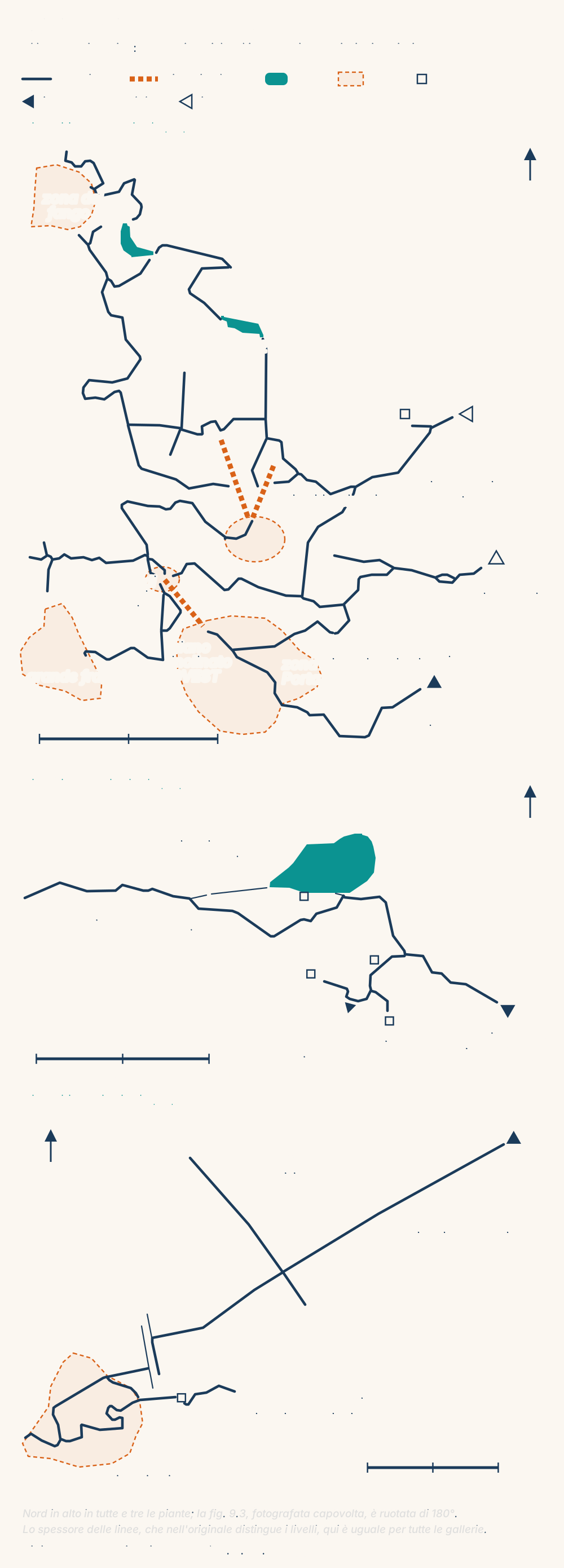
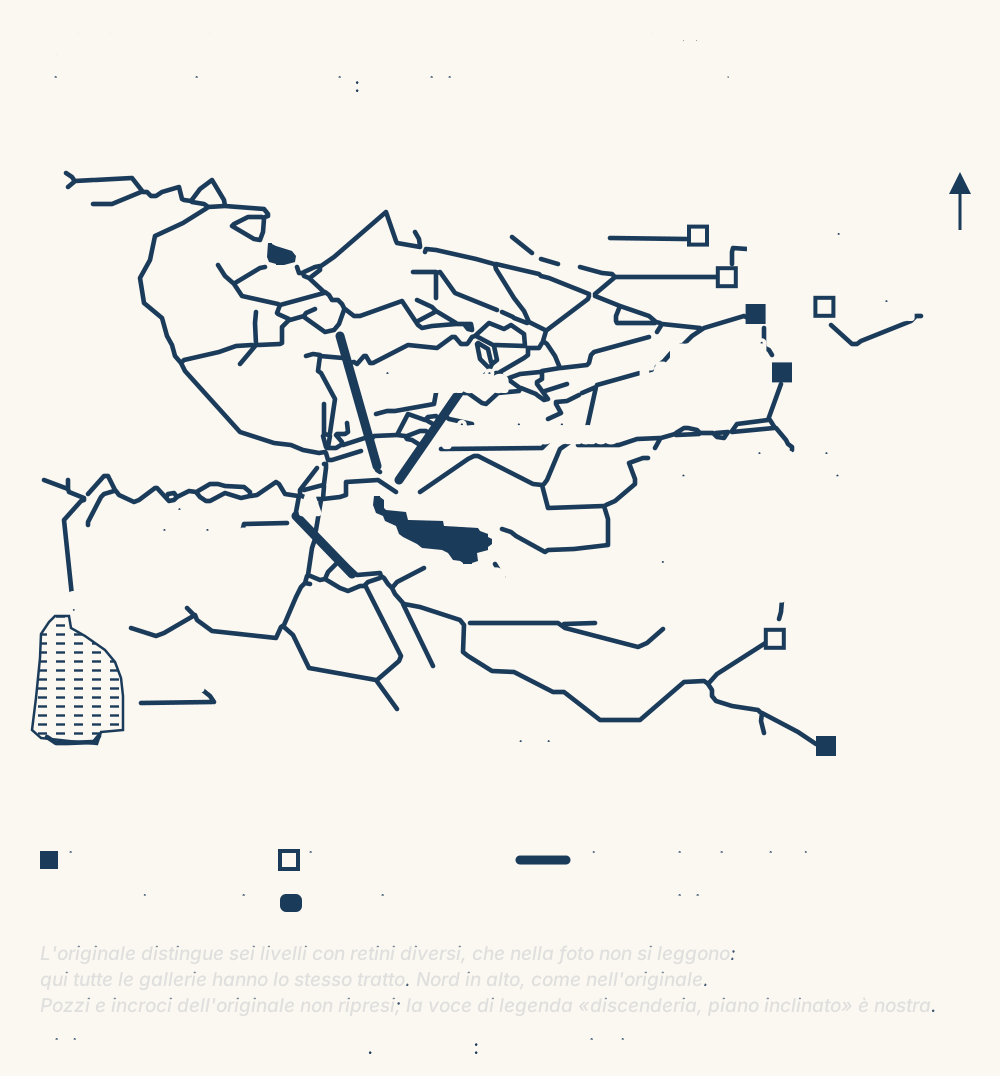
Maps tell what the texts do not say. A plan of 26 July 1821 shows the croso of M. Colombotto with the parts dug out, the tunnel and the mine yard. The plans by Falquet and Banchieri are in the State Archives of Turin: Berattino publishes some of them, but the handwritten legends are illegible at the scale of the book. For Brosso, Chiappino uses as her base a 1924 plan of the workings and numbers on it seventeen surface buildings of the mine.
Surveying the tunnels is difficult. In 2001-2002 Beratto measured with a 100-metre tape and without a compass, useless near magnetite, only some stretches of the five levels of Traversella; the rest comes from the plans and from the archive boreholes. At Brosso the magnetite deflected Chiappino's compass by as much as 50-60 degrees. The altitudes do not always agree either: the Anglosarda level is at 778 metres in Beratto's text, at 776.50 on his section, at 774 and at 779 in Torti uncertain.
Sources: Costa, Garabello 2022, slide 17; Berattino 1988, pp. 142, 147, 163-164, 169, 179; Chiappino 1996, pp. 56, 60-61, 64-65, fig. 10.1; Beratto (thesis), pp. 34, 60; Torti 1973, pp. 6, 33
What we still do not know
Many documents are lost. According to Munari the archive of Vico, which included Brosso, was burnt by the Nazis probable; the ecomuseum writes that much of the historical documentation of Brosso was destroyed in the Second World War and that the parish archive was dispersed. The filmed interviews with three former workers of Brosso, listed by the ecomuseum's media library, can no longer be reached probable.
Other answers lie in texts that have not yet been read. Only the full text by Mapelli and Nicodemi can say where the direct-reduction furnaces of the late 18th century stood uncertain; Munari's paper on the road of the workshops along the Chiusella is unpublished uncertain. The 1900 monograph by Sclopis and Bonacossa might say whether a ropeway towards Montalto already existed before the cableway of 1907 uncertain. We do not even know where Sella's machines worked: that they stood at Le Folle, next to the Riccardi copper foundry, is only a hypothesis uncertain. Finally, Vescovo points out theses and articles on Brosso still to be read, among them those by Cima on iron metallurgy in the Alps of the Canavese.
Sources: Munari 2020, slide 7; the Brosso ecomuseum's pages, «I documenti» and «Filmati»; Mapelli, Nicodemi 2004 (abstract); AIPSAM programme 2022, p. 2; Chiappino 1996, fig. 6.1, p. 48; Berattino 1988, p. 94; Burci 1860, p. 25; Vescovo 2002, pp. 91-92
Sources for this page
- A. Bertolotti, Statuti minerari della Valle di Brosso del secolo XV, Turin, Stamperia Reale, 1871.
- G. Berattino, Le miniere dei «Baduj» di Traversella, Ivrea, Ferraro, 1988.
- G. Burci, L'elettricità applicata alla preparazione meccanica del minerale di rame estratto dalla miniera di Traversella in Piemonte, Pisa, Tipografia Pieraccini, 1860.
- F. Zampari, Relazione sulla miniera di pirite di ferro di Brozzo dei Fratelli Sclopis, Turin, 28 December 1862 (unnumbered pages, counted 1-3).
- O. Coletti, Sull'industria ferriera nell'alta Valle d'Aosta, Turin, Stamperia dell'Unione Tipografico-Editrice, 1857.
- G. Jervis, I tesori sotterranei dell'Italia, vol. 1 (Alpi), Turin, Loescher, 1873.
- V. Novarese, L'origine dei giacimenti metalliferi di Brosso e Traversella in Piemonte, in «Bollettino del R. Comitato Geologico d'Italia», 32, 1901, pp. 75-93.
- E. Costa, G.A. Dino, P. Benna, P. Rossetti, The Traversella Mining Site as Piemonte Geosite, in «Geoheritage», 11(1), 2019, pp. 55-70 (page numbers are those of the post-print, 1-24).
- E. Costa, D. Garabello, La produzione di magnetite a Traversella (Lo sfruttamento delle miniere durante il XVIII e XIX secolo), presentation at the AIPSAM round table, Traversella, 1 October 2022 (slides are cited).
- C. Chiappino, Le miniere di Brosso: un patrimonio millenario di storia umana e scientifica, in «Opera Ipogea», 1/2010, pp. 23-30.
- C. Chiappino, Recupero e valorizzazione a scopo museale della Miniera di Brosso, degree thesis in Engineering, Politecnico di Torino, 1996.
- M. Vescovo, Situazione storico-economica della Valle di Brosso dal XV al XX secolo, final dissertation, Faculty of Political Science, University of Turin, academic year 2001/2002.
- R. Beratto, Studio geologico dei corpi minerari del giacimento di Traversella, degree thesis in Geological Sciences, University of Turin (year not given; survey in the tunnels 2001-2002).
- R. Torti, La miniera di Traversella e i suoi minerali, Quaderno GML no. 10, Milan, Gruppo Mineralogico Lombardo, 1973.
- F. Barello, F. Rubat Borel, Traversella, località Balma Bianca. Rinvenimento di monete tardoantiche all'ingresso di una miniera, in «Quaderni di archeologia del Piemonte», 3, 2019, pp. 176-178.
- F. Barello, La frequentazione della miniera di Balma Bianca attraverso un importante rinvenimento numismatico tardoantico, presentation at the AIPSAM round table, Traversella, 1 October 2022.
- G. Baldassarre et al., Exploring the Recovery Potential of Critical and Strategic Raw Materials from Traversella Mine (Piedmont, Italy) Waste: A Comparison of Laboratory-Scale Separation Techniques, in «Mining», 5(2): 21, 2025.
- C. Mapelli, W. Nicodemi, Study of the working conditions of the furnaces for direct reduction present in Chiusella valley at the end of the 18th century, in «Revue de Métallurgie», 101(12), 2004, pp. 1101-1109 (only the abstract has been read).
- AIPSAM, Tavola rotonda di archeologia mineraria, Traversella 1/10/2022: programma.
- P. Munari, Piemonte archeo-minerario. Miniere e opifici: da risorsa strategica a patrimonio storico-ambientale, slides of the Rueglio lecture of 16 August 2020, published by AIPSAM in 2022.
- M. Pedron, Il mineur, il minatore, meer.com, 21 February 2018. (popular work)
- Provincia di Torino, Ecomuseo, Museo mineralogico di Brosso and Centro minerario di cultura di Traversella, online pages (website closed; Internet Archive copies), consulted on 16 October 2026.
- inalto.org, Sentiero delle Vote da Calea, online page, consulted on 15 October 2026. (popular work)
- minieredoro.it, Traversella miniera, online page, consulted on 16 October 2026. (popular work)